
Middle Eastern petrodollars are increasingly flowing into Africa’s clean energy sector, driven by long-term strategic returns, rising power demand, and escalating geopolitical instability in the Persian Gulf.
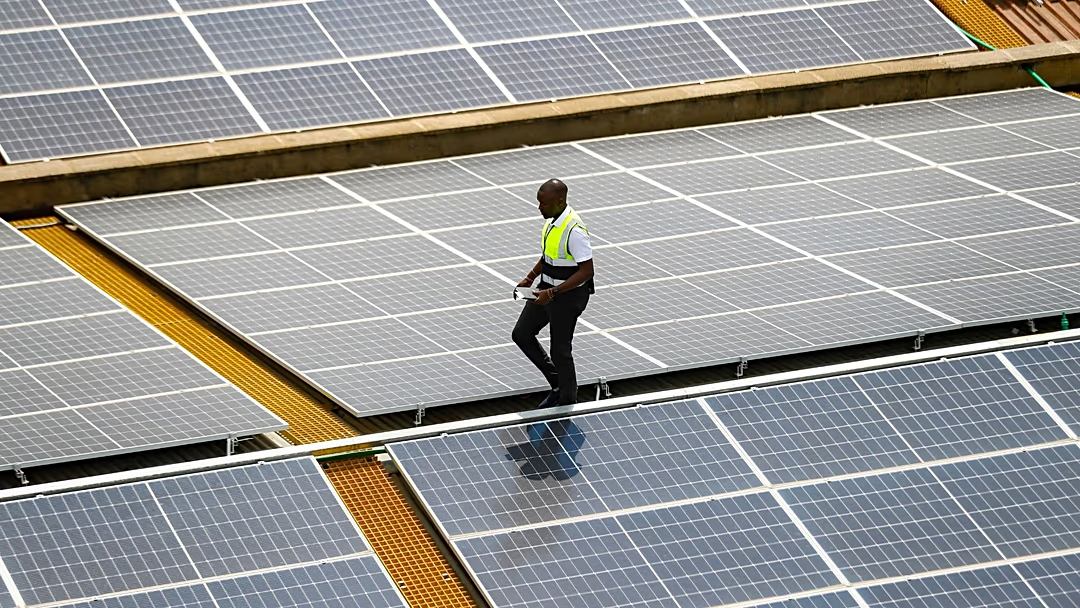
Investors from the Gulf Cooperation Council (GCC)—led by the United Arab Emirates, Saudi Arabia, Qatar, Kuwait, and Bahrain—poured more than $101.9 billion (€88.8 billion) into African renewable energy projects by the end of 2024, according to a report by the Clean Air Task Force.
Middle Eastern sovereign wealth funds and state-backed entities are unlikely to retreat from these clean-tech deployments despite market volatility caused by ongoing regional conflict, analysts say. With roughly 600 million people across Africa lacking access to electricity, the continent offers a structural growth profile that few other global markets can match.
“Africa remains one of the few regions where demand growth is unequivocal,” said Matthew Tilleard, Chief Executive Officer of Nairobi-based developer CrossBoundary Energy. “Short-term shocks may delay individual transactions, but the biggest infrastructure opportunities require a long-term view of risk and value.”
The capital influx is being propelled by rapid urbanization and Africa’s emerging position in global critical mineral supply chains, including cobalt and gold extraction. For Gulf state-backed entities seeking to hedge against a long-term global transition away from fossil fuels, these assets provide strategic entry points into wider industrial value chains.
“Power plants built to supply mines, or large industrial operations, can position Arab investors close to supply chains for minerals used in batteries and other technologies,” Tilleard noted.
While much of the deployment to date has concentrated in North, Southern, and East Africa, systemic bottlenecks remain. Energy analysts point out that thin transmission grids, policy uncertainty, and currency volatility—particularly in West Africa—continue to dictate capital allocation.
“Generating power is only one part of the equation,” said Joab Okanda, an energy and development analyst. “You also need transmission systems and a functioning electricity market where the electricity can actually be sold and paid for.”
Despite those hurdles, the broader strategic rationale is firming up. Disruptions to traditional energy shipping lanes have highlighted the fragility of fossil-fuel reliance, incentivizing state-backed capital to lock in long-term positions in future energy architectures.
“Ultimately, Gulf investments in Africa tend to be driven by pragmatic national interests and strategic returns,” said Louw Nelson, political analyst at Oxford Economics. “There is currently a significant amount of energy investment underway across Africa… so we don’t anticipate major disruptions.”
