

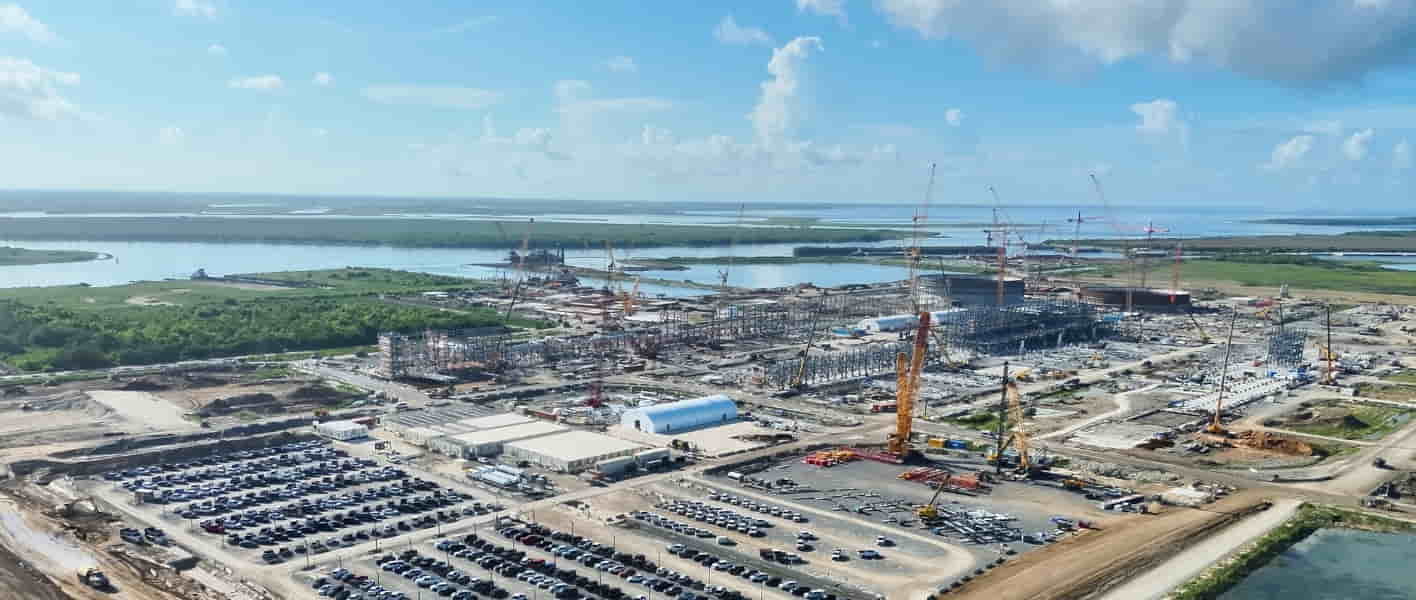
Along the shores of Calcasieu Parish, nestled in the Gulf Coast region between Houston and New Orleans, the horizon of Southwest Louisiana is rapidly transforming. Australian energy titan Woodside is forging ahead with its ambitious $17.5 billion Louisiana LNG project, marking major construction milestones as the industrial giant steadily marches toward its scheduled first cargo delivery in 2029.
More than 14 months after securing its final investment decision, momentum at the Pelican State site is gathering serious speed. By the end of the second quarter, the massive buildout reached 28% completion overall, remaining strictly on budget. Structural steel now frame the foundation of two LNG liquefaction trains, while concrete pilings are underway for a third. Individual train progress highlights the project’s fast-paced expansion: Train 1 stands at 35% complete, Train 2 at 25%, and Train 3 at 18%.
At the center of this industrial effort are two storage units designed to break regional records. Upon completion, these structures will claim the title of North America’s largest LNG storage tanks. Holding an astonishing 235,000 cubic meters each—equivalent to more than 90 Olympic-sized swimming pools—the structures took a significant step forward as crews began installing roof panels on Tank 1. Concurrently, dredging operations at Berth 1 are actively shaping the deepwater access needed for international LNG carriers to dock.
Rachel Archer, Acting SVP for Louisiana LNG, highlighted the momentum behind the site’s rapid evolution:
“Louisiana LNG continues to make strong progress as we safely advance construction and deliver key project milestones. Every achievement reflects the dedication of our teams, partners and contractors, and reinforces our commitment to creating lasting economic opportunities for Southwest Louisiana while responsibly delivering energy to global markets.”
Woodside’s strategy leverages the region’s geographical advantage—direct access to low-cost, abundant U.S. natural gas. With total site permits allowing for up to 27.6 million tonnes per annum (mtpa), the initial three-train foundation targets a massive 16.5 mtpa capacity, with operational design already accommodating a future two-train expansion. Local economic integration remains a core focus; the operator recently awarded Louisiana-based supplier Green Tug Towing the contract to design and build four specialized tugboats for marine operations.
As civil engineering works give way to vertical assembly, the growing operational team maintains a sharp focus on site safety, completing tank containment walls, and progressing jetty infrastructure—ensuring the Gulf Coast remains central to the future of global energy exports.
