

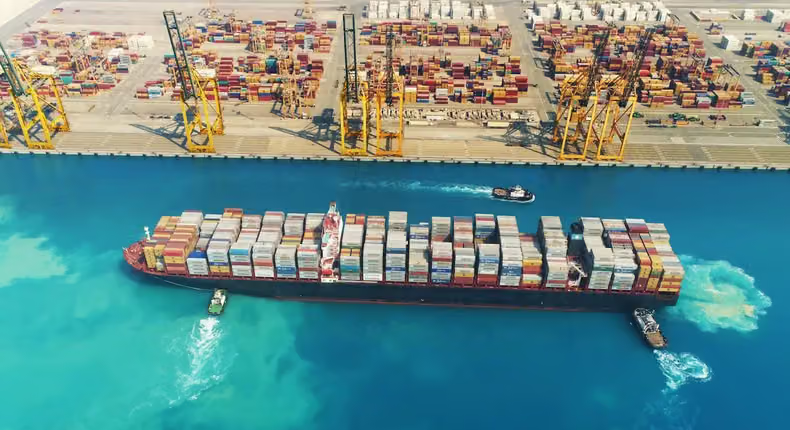
Across the African continent, a new economic landscape is taking shape—not built on traditional Western aid or long-standing Chinese loans, but powered by the deep pockets of the United Arab Emirates. From expanding Mozambique’s Maputo port to breaking ground on the Democratic Republic of Congo’s first deep-water port, Emirati conglomerates are rapidly securing control over the arteries of African commerce.
Since 2017, UAE-backed entities have announced an eye-watering pipeline exceeding $168 billion, targeting strategic sectors like critical mining, logistics, commercial agriculture, and green energy. Heavyweights like DP World and Abu Dhabi Ports now hold concessions or operate logistics hubs across 13 African nations.
Yet, as the ink dries on these massive concessions, African leadership is facing a crucial juncture: Will this capital wave build enduring domestic industries, or simply construct a sleeker, faster conveyor belt for raw materials bound for global markets?
Redefining the Trade Corridor
Logistics operators are moving beyond managing individual piers; they are acquiring the connected arteries that feed them. By linking coastal deep-water ports with inland rail lines, dry terminals, and special economic zones, Emirati entities are effectively controlling whole trade corridors.
For cash-strapped governments, the immediate benefits are clear—reduced transit delays, modern facilities, and instant global connectivity. However, giving a foreign enterprise key levers over a country’s trade route carries deep strategic implications.
As other nations take notice—such as Saudi Arabia’s recent push for Cape Town port assets—Gulf capital is aggressively competing for the continent’s backbone infrastructure.
“A port concession can lower shipping delays and improve access to global markets. It can also give a foreign operator a central position in trade corridors that link exporters, manufacturers, and consumers.”
Moving Beyond Extraction
The true test for African governments lies in capturing value beyond the dockyard. Historically, foreign investments left behind bare-bones extraction setups—raw ores shipped out, while processing facilities, skilled jobs, and refined high-value products remained overseas.
African nations with critical energy transition minerals are demanding a different playbook. Leaders are using their resources as leverage to mandate local processing plants, regional grid support, and domestic supply chain quotas alongside basic royalty agreements.
Take Namibia’s recent multi-front negotiations, where the government pushed major trade partners for local beneficiation rather than simple mineral extraction.
“A new terminal linked only to a foreign-owned mine can make raw-material exports faster. A terminal connected to industrial zones, rail networks, and local suppliers can lower costs for manufacturers, farmers, and smaller exporters.”
A New Era of African Strategic Leverage
The sudden rise of the UAE as a dominant investor gives African policymakers unprecedented room to maneuver. Rather than relying on a single dominant foreign lender, governments can pit competing bids from Gulf funds, Beijing, Brussels, and Washington against one another.
This rivalry provides African states the power to negotiate stricter local-content requirements, transfer of technical knowledge, and shared usage rights for key transport links.
An impressive investment pipeline offers immediate promise, but concrete economic independence requires strategic foresight. The countries that succeed will be those that insist on clear infrastructure guarantees and domestic manufacturing terms long before the ribbon-cutting ceremonies take place.
