

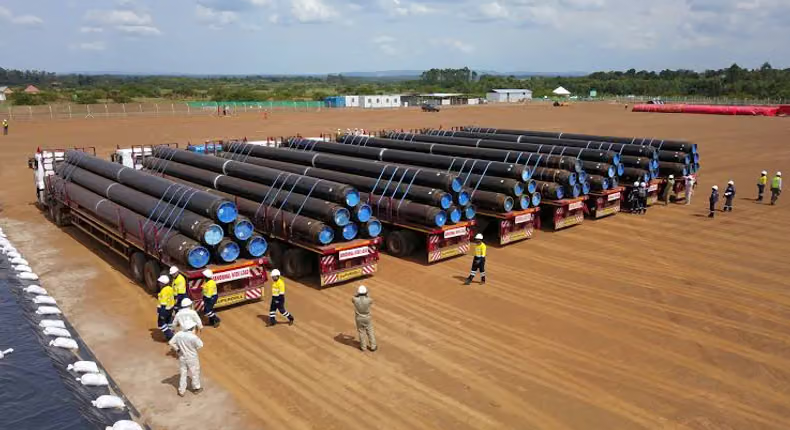
Persian Gulf crude producers are accelerating a multibillion-dollar infrastructure drive to bypass the Strait of Hormuz, a strategic pivot that threatens to alter global energy routes and place Africa’s Red Sea coastline at the center of the international oil trade.
Escalating conflict with Iran has disrupted shipping through the narrow waterway, which historically carried roughly 15 million barrels of crude per day. With Brent crude holding above $100 a barrel, governments across the region are advancing at least seven pipeline projects—currently under construction, in advanced planning, or under negotiation—to transport crude directly to export terminals on the Red Sea, the Gulf of Oman, and the Mediterranean.
The push could redirect a vast portion of the Middle East’s oil exports to African coastal nations including Egypt, Sudan, Eritrea, and Djibouti. Goldman Sachs Group Inc. estimates that bypass capacity will rise by 3.8 million barrels a day by the end of 2027 and reach 7.3 million barrels per day by 2028. If fully realized, as much as 60% of pre-conflict export volumes could bypass the Strait entirely.
The diversion builds on existing bypass infrastructure, notably Saudi Arabia’s East-West Pipeline linking Abqaiq to Yanbu on the Red Sea, and the United Arab Emirates’ $3 billion line to Fujairah on the Gulf of Oman, which is set for completion by mid-2027. Simultaneously, Iraq is assessing export routes via Turkey and Syria capable of handling up to 2 million barrels daily, alongside proposed connections to Jordan’s Aqaba port on the Red Sea.
Yet, the alternative corridors bring their own logistical and geopolitical hurdles. Houthi militant strikes in the Red Sea—including recent attacks targeting Saudi tankers—highlight that export channels outside the Gulf remain exposed. Furthermore, routing crude to European and Asian buyers via the Mediterranean can incur higher transport costs and longer transit times around Africa, particularly as the Suez Canal cannot accommodate fully laden Very Large Crude Carriers (VLCCs).
Despite those headwinds, energy analysts view the ongoing infrastructure shift as a permanent realignment of global supply chains. By anchoring future crude flows to Red Sea terminals, Persian Gulf states are attempting to permanently insulate their state revenues from Iranian chokepoint leverage, irrevocably elevating the geopolitical weight of East Africa’s maritime rim.
